How to Choose a Pet Water Fountain Manufacturer: A 2026 Sourcing Checklist
Two stainless steel pet water fountains can look identical in a product photo — and behave completely differently six months into a customer’s kitchen. The difference is almost never the design. It is the manufacturer behind it. This checklist is written from our side of the table: what we would ask, and what we would worry about, before placing a serious order with any pet water fountain factory.
Published September 2, 2026 · 6 min read · by the Inoxpaw factory team
What Separates a Good Manufacturer from a Bad One
A pet water fountain is a small electro-mechanical product with a demanding job: it runs continuously, in water, inside a customer’s home, for years. That puts three things under constant stress — the pump, the seals, and the steel or plastic it is made from.
Weak manufacturers cut cost exactly where buyers cannot see it: a pump rated for 8,000 hours instead of 20,000, 201 stainless passed off as food-grade 304, uncertified power adapters, filter media with no specification sheet. Six months later, those invisible decisions become your return rate and your review stars.
A good manufacturer can prove — not promise — what is inside the box. That is what the checklist below is for.
The 8-Point Vetting Checklist
| 1. Factory or trading company? | Ask for a live video walk-through of the assembly and QC lines at an agreed time. A real factory can show you lines running within 48 hours; a reseller will offer stock photos and excuses. |
|---|---|
| 2. Material documentation | Request mill certificates for the stainless steel and food-contact compliance statements for every water-contact part. Certificates should carry batch numbers that can be matched to your production lot. |
| 3. Electrical safety | For the EU market: CE and RoHS. For the US: FCC. Ask for certificate numbers and issuing bodies — then verify them. “We can get any certificate you want” is not an answer. |
| 4. OEM/ODM track record | Ask for anonymized samples of past customization: laser logos, printed color boxes, multilingual manuals. An experienced partner shows you a portfolio; a beginner shows you mockups. |
| 5. QC process | Ask what happens before goods leave the factory: AQL sampling levels, 100% pump function tests, noise checks, leak tests. It should exist as a written protocol, not a verbal assurance. |
| 6. MOQ and scaling | Confirm the minimum for a first order and the lead time at 3–5× that volume. A flexible factory — for example, MOQ 500 pcs with a 30-day lead time — leaves you room to test the market before committing. |
| 7. Export experience | Your supplier should quote FOB terms confidently, issue packing lists and commercial invoices without prompting, and know what EPR and packaging rules await the goods in the destination market. |
| 8. After-sales policy | Pumps and filters are wear parts. Ask about warranty terms, spare-part availability and how defects on landed goods are handled — before you need the answer. |
Red Flags That Should End the Conversation
- A unit price dramatically below every other quote. Something was swapped — usually the steel grade or the pump.
- Certificates that exist only as untraceable image files.
- No sample policy, or samples priced like a punishment.
- Pressure to confirm an order before you have tested a sample.
- Precise questions answered with marketing language.
The 304 vs 201 Trap
The single most common bait-and-switch in this category is 201 stainless sold as 304. Both polish to a similar shine in photos. But 201 contains far less nickel and corrodes in continuous water contact — first as surface rust spots, then as pitting where water sits. On a product that runs 24/7, that is not a cosmetic issue; it is a warranty claim waiting to happen.
Three protections: ask for mill certificates with batch numbers, run a corrosion spot test on your samples (salt water, 48 hours), and keep a sealed reference sample from your first production lot. We compare the two grades in more depth in our stainless steel vs plastic comparison.
Questions Worth Asking on the First Call
- What is your MOQ for a first order, and the unit price at 1,000 and 3,000 pieces?
- Can we schedule a video walk-through of the line this week?
- Which parts are 304 stainless — and which parts touch water but are not?
- What is the pump’s rated lifetime, and is it user-replaceable?
- What exactly does your QC check before shipment?
- Can you share certificate numbers for CE, FCC and RoHS?
- What is the warranty policy, and how do you ship spare parts?
- What is your lead time for a repeat order of the same configuration?
What Factory-Direct Looks Like in Practice
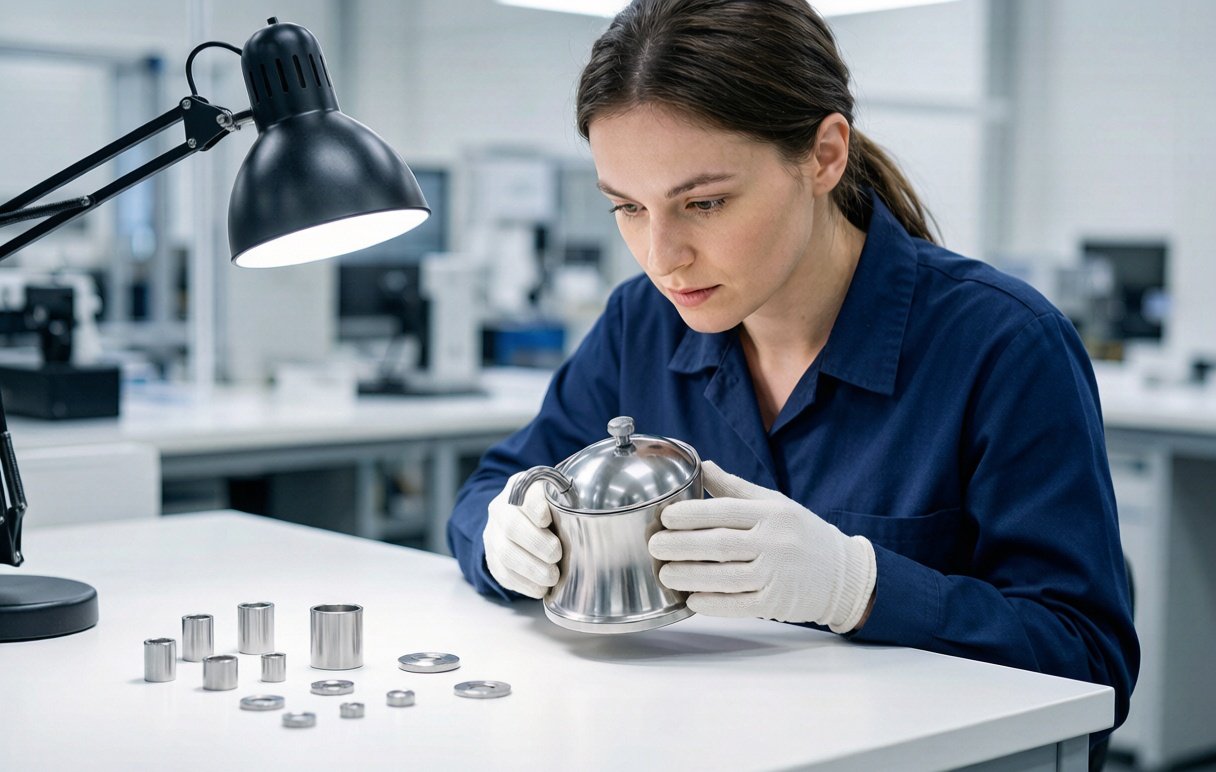
We build both of our fountains — the octagonal Inox-3201 and the four-leaf-clover INOX-WF-LC01 — in our own Xuzhou facility: food-grade 304 stainless on every water-contact part, CE / FCC / RoHS documentation, MOQ from 500 pcs, and full OEM/ODM support from laser logo to retail-ready packaging. Samples always ship before any bulk commitment.
The fastest way to pressure-test us against this checklist is a message.
Put This Checklist to Work
Send us your target quantity and destination market — we will answer with pricing, certificate numbers and a sample plan within one business day.