Pet Water Fountain Market Trends for 2026: What Buyers Should Stock
Ask three research firms for the size of the pet water fountain market and you will get three different answers — published estimates range from a couple of hundred million dollars to several billion, depending on where each firm draws the category boundary. The direction, however, is unanimous: this category is growing, and the growth has a shape. These are the five trends we see from the factory floor that should shape your 2026 assortment.
Published September 6, 2026 · 5 min read · by the Inoxpaw factory team
What Is Driving the Category
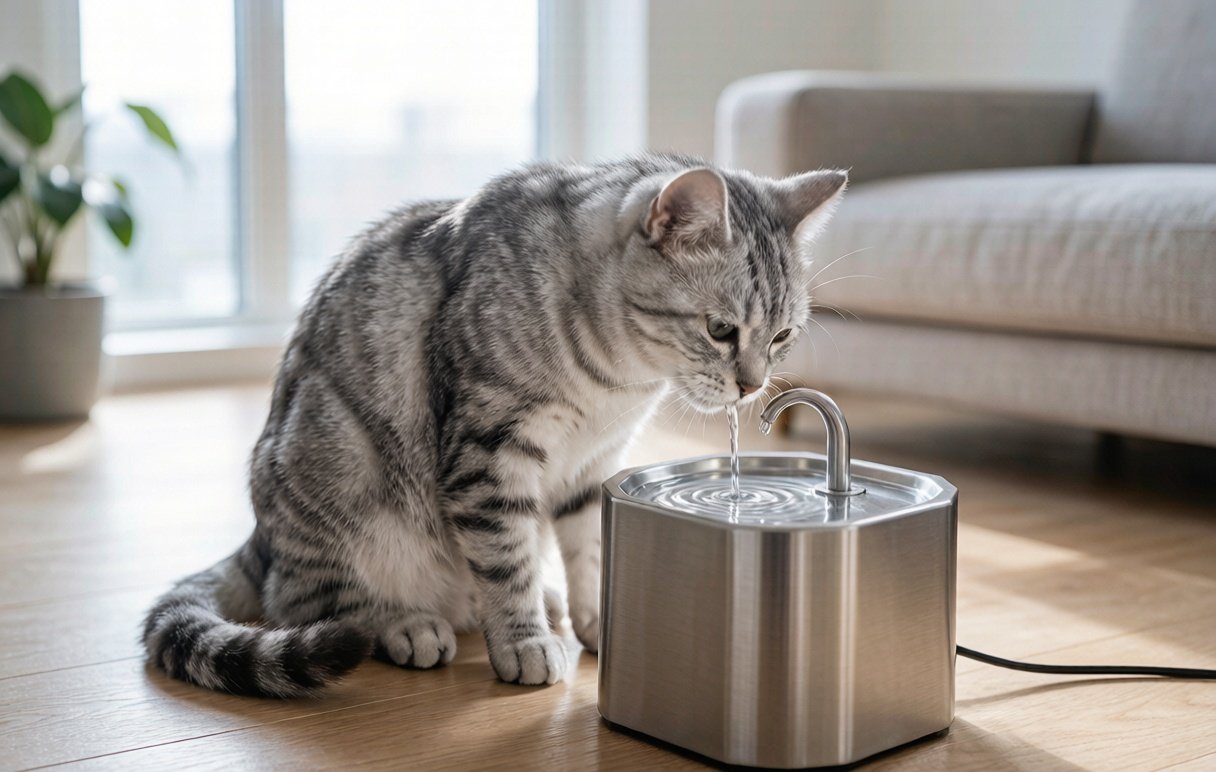
Four forces, none of them seasonal and none of them cyclical: pet humanization (pets treated as family members with their own product standards), hydration awareness (fountains market themselves on pet kidney health), multi-pet households (more mouths, bigger tanks), and premiumization (the same wallet upgrade that moved pet food upscale). Fountains began as a cat product; small and medium dog households are now the fastest-growing segment.
Trend 1 — Stainless Steel Goes Mainstream
BPA anxiety, visible slime on aging plastic, and a review culture that punishes both: stainless has moved from premium niche to expected upgrade. Listings that say “food-grade 304 stainless” convert the way “BPA-free” did a decade ago. We break down the full material comparison in stainless vs plastic: which should you stock.
Sourcing takeaway: if your catalog has no stainless SKU in 2026, you are conceding the premium shelf to someone who does.
Trend 2 — Ultra-Quiet Becomes the Baseline
Noise was the number-one complaint of first-generation fountains. The current benchmark for bedroom-grade quiet is ≤25 dB — quiet enough that the pump is inaudible from across a room. Treat the decibel figure as a spec to verify, not a slogan to print: ask how it is measured and whether every unit is tested before shipment.
Sourcing takeaway: verify the dB claim on samples, in a quiet room, at night. Your customers will.
Trend 3 — Filtration Becomes a Revenue Model
Every fountain sold is a subscription in disguise: filter cartridges need replacing every 2–4 weeks. Smart sellers treat consumables as the business and hardware as the acquisition channel — bundling extra filters at first purchase, then capturing repeat orders. That only works if your supplier stocks the consumables reliably and prices them for resale, not as an afterthought.
Sourcing takeaway: negotiate filter pricing and availability with the same seriousness as the fountain itself.
Trend 4 — Smart Features at the Premium End
App control, water-level sensing and usage tracking are appearing at the top of the price range. Our view, from building connected hardware: pet parents pay for reliability first and features second. A smart fountain with an unreliable pump is a one-star review with Wi-Fi. If you add smart SKUs, add them on a proven mechanical platform.
Sourcing takeaway: smart is a differentiator, not a substitute for the basics.
Trend 5 — Multipacks and Bundles
Multi-pet households and small-retailer restocks are pushing 2-pack and 6-pack configurations. Multipacks also improve freight economics — a fountain is mostly air, and shipping two per carton beats shipping one. If you sell on marketplaces, a multipack listing differentiates you from single-unit sellers without touching your unit margin.
Sourcing takeaway: ask for multipack carton specs and per-unit freight before you commit to pack configuration.
What This Means for Your 2026 Assortment
The shape that falls out of these five trends: one premium stainless hero (our octagonal Inox-3201 is built exactly for that slot), one value stainless or entry plastic SKU, filters stocked deep enough to never stock out, and at least one multipack listing for multi-pet buyers. Add smart features only on a platform you trust.
Plan Your 2026 Assortment With Us
Tell us your channels and target markets — we will suggest a SKU mix, pack configurations and a filter supply plan that fits.